






 Trap
 Normal
Accumulated Fortune
View:
3933
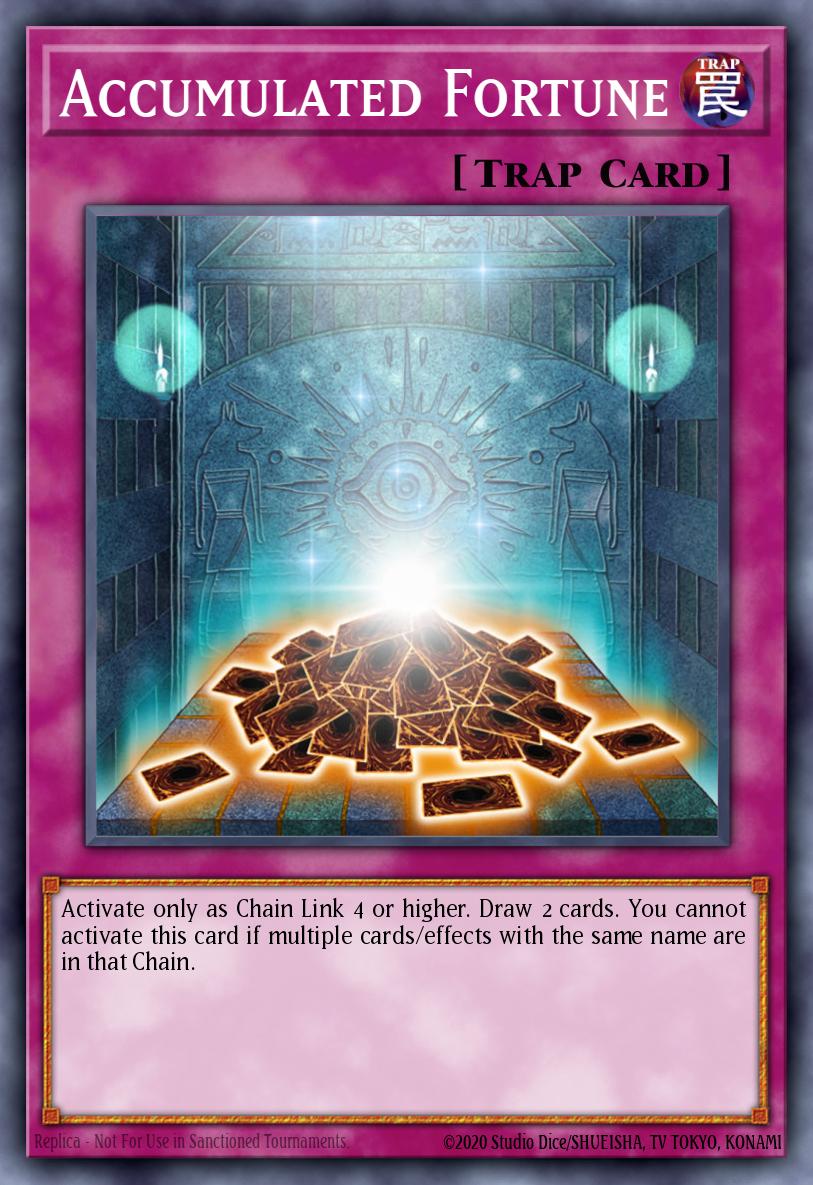
Activate only as Chain Link 4 or higher. Draw 2 cards. You cannot activate this card if multiple cards/effects with the same name are in that Chain.
Accumulated Fortune — Power Evaluation
Final Score: 47 ± 6 · Confidence: Medium
- Intrinsic: 46 · Deck: 48 · Meta: provisional
- Primary role: Utility
Why it scores here
Accumulated Fortune is a conditional draw-2 trap: it converts one set trap into two cards, a net +1 of card advantage, but only once the chain reaches link 4 or higher. The score comes from reliable card advantage and a cheap, generic slot that runs in 148 of the sampled decks across 29 archetypes, not from any board or interaction. No combo data exists, so combo conversion stays low and is text-only inference. The chain-link condition and the set-then-wait requirement keep accessibility middling.
Axis scores
| Axis | Score | Evidence |
|---|---|---|
| Accessibility | 45 | A set trap that needs chain link 4+ to activate is hard to time, though it is live in 148 decks and appears in 2.17 copies on average (decks_evidence; inference from text for the timing) (observed/inferred). |
| Combo & Conversion | 30 | No recorded boards exist (total_combos 0), so the only conversion is text: draw 2 with no board impact (inferred). |
| Resource Economy | 65 | Card text draws 2 for one trap card, a net +1 advantage with no GY refuel (verified from card text; inferred for the net value). |
| Effect & Interaction | 10 | No negation, removal or disruption in the text; it only draws (verified). |
| Material Utility | 5 | A Normal Trap cannot be used as material and has no body (verified from card type). |
| Resilience & Flexibility | 40 | Set face-down, so it can be negated and is exposed to chain-link timing; redundancy comes from 2–3 copies in most decks (verified text; observed decks_evidence). |
| Deck-Building Efficiency | 75 | One generic slot with no garnet or lock; 1–3 copies run in 148 of 148 decks, so it is near free-roll (observed decks_evidence). |
Calculation
Weight profile: Utility / no clear role (default); no secondary role blended. Intrinsic ≈ 46, Deck ≈ 48, Meta = provisional. Modifiers: none. Final formula: 0.40*Intrinsic + 0.60*Deck
Strengths
- Two-card draw for a single trap card, so net card advantage is +1
- Generic, cheap slot that fits 29 archetypes
- Runs in most sampled decks, with a 3-copy tier in 49 of 148 decks
Weaknesses
- Only activates at chain link 4 or higher, which is hard to force
- Set trap that can be negated before it resolves
- No board presence or interaction
Counters / choke points
- Negation of the set trap before activation
- Opponent who does not build chain length
Best use
Card-advantage trap in decks that already build chains or run a generic trap suite. Decks: Exodia, Chain Burn, Paleozoic, Greed. Suggested copies: 2.
Evidence & gaps
- Verified: Trap card, Normal race, draws 2, activates only at chain link 4 or higher (card text); Cannot be used as material (card type); Legal in TCG, OCG, MasterDuel, DuelLinks (formats)
- Observed: Present in 148 sampled decks, 2.17 copies on average, 3 copies in 49 decks (decks_evidence); Top partners Waboku, Threatening Roar, Reckless Greed (decks_evidence); 0 combos recorded (combos_evidence)
- Inferred: Net +1 card advantage counts as the main resource value; Chain link 4 is hard to force, which lowers accessibility; Deck resilience is moderate given the concentration in Exodia
- Data gaps: no combos supplied — combo conversion is text-only inference no banlist token — assumed 3 copies (unlimited) no usage statistics (StatisticsCard) — archetype inclusion % inferred from deck sample only no guide content beyond one Paleozoic guide snippet